Last month marked 20 years since my Christianity Today cover story “Young, Restless, Reformed.” And last year, we recognized 20 years since the founding of The Gospel Coalition. During TGC’s most recent Colloquium, a private meeting of our Council, president Mark Vroegop asked me to reflect on the “Not-So-Young, Restless, Reformed.”
I took his prompt as an occasion to reflect on four eras that have unfolded over those 20-plus years, noting distinctive characteristics of ministry amid the changing tides. Then I reflected on the perspective we bring to cultural change, with an emphasis on the benefits of focusing on the deeper structures that don’t change as often. The result, I hope, helps church leaders understand the times without overreacting to superficial trends—all the while staying focused on God’s unchanging promises.
In This Episode
00:00 – Reflecting on the Young, Restless Reformed movement’s influence
02:39 – Defining gospel-centeredness in modern evangelical discourse
04:20 – Church rupture over gay marriage
05:35 – Evolution and influence of The Gospel Coalition
11:07 – Intersection of theology, suffering, and political engagement
14:29 – Rise and fall of the Young, Restless, Reformed movement
19:20 – Intersection of politics, society, and technological change
27:18 – Navigating church dynamics amid rapid cultural and political changes
31:00 – Christian materialism, Platonism, and the future of the West
Resources Mentioned:
- The Gospel Coalition
- The Keller Center for Cultural Apologetics
- Gospel-Centered Ministry by Don Carson and Tim Keller
- A History of the Work of Redemption by Jonathan Edwards
- A Secular Age by Charles Taylor
- The Righteous Mind by Jonathan Haidt
- A God-Sized Vision by Collin Hansen and John D. Woodbridge
- City of God by Augustine
SIGN UP for my newsletter, Unseen Things.
Help The Gospel Coalition renew and unify the contemporary church in the ancient gospel: Donate today.
Don’t miss an episode of Gospelbound with Collin Hansen:
Transcript
The following is an uncorrected transcript generated by a transcription service. Before quoting in print, please check the corresponding audio for accuracy.
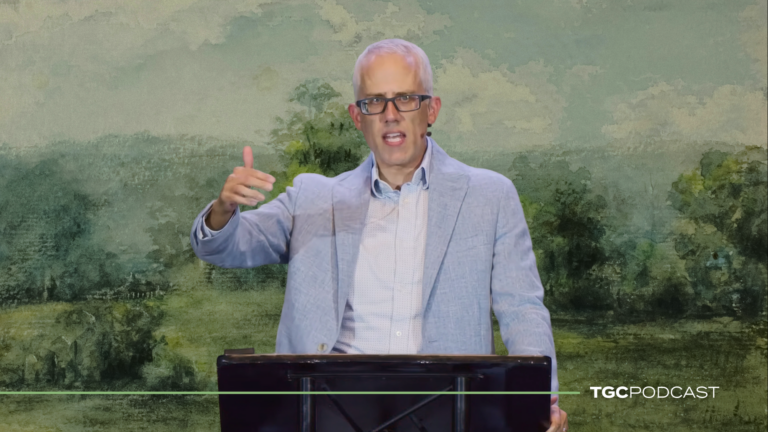
0:00:00 – (Collin Hansen): Over the years, Mark Vrogapp and I would. Some of the things that I would look forward to is Mark would be working through something in his church, experiencing something, and he’d call and we would just talk about, hey, what’s going on? And I think there are two ways to think broadly about how to understand what’s happening in your immediate context. One thing to do is simply to zoom out, to look back over history, to see things not only from that historical perspective, but even recent history. Sometimes just putting everything in a list, putting everything on the wall, just being able to encounter that. You’re gonna see a spot we get to in this presentation that I’ll be surprised if a lot of you don’t have some feelings of anxiety start to well up in you as you see this slide, and you start to think about all those things that happened. So you can look back over history. But I think one of the beautiful things about the Gospel Coalition is that you also get to come into a room like this and you get to hear from people, you get to talk to people, you get to pray with people who are in very different ministry contexts, different church size, different church denomination, different age in ministry, different ethnicity. We could go on and on and on here, but I think it’s one of the really significant advantages of what we’re doing. So what we’ll try to establish here in this first talk, we’ll go for half an hour here, invite up the panel, we’ll talk for another half an hour, and then we’ll take some questions for a final half hour to round out our 90 minutes. But we’re gonna take a look back on really the first quarter century of the 21st century so far, specifically through the lens of the young, restless Reformed, to try to help get some perspective on what God has been doing in your churches, what he’s been doing in your life, some of the challenges that you face, some of the challenges that you are facing, but hopefully in the end, working toward hope about where we’re going, hope about what God is doing, and how you can feel best equipped to be able to respond to whatever unique challenges are arising.
0:02:08 – (Collin Hansen): Okay, so Mark’s already done a little bit of this, but I want to go back and especially camp for a little bit on the year 2005 to level set. I know everybody to understand what were we dealing with at the time? What was in the air? What was this body trying to do? 2005, of course, which we do date back to TGC’s founding, was just a meeting. There was no Gospel Coalition. There was a discussion, should we do this?
0:02:39 – (Collin Hansen): There were questions to Ligon in that meeting saying, well, what about ace? Is ACE doing this thing? Lancet Confessing Evangelicals. Is there any room? Is there any need for this? That discussion in the notes went on for quite a long time, but there were two landmark addresses that thankfully we have the notes from. We don’t have any media. We didn’t have this sophisticated setup back then, but we did have the notes taken from that meeting.
0:03:05 – (Collin Hansen): And so I want to start off with this is something we actually talked about in the last board meeting and there was a discussion about should we still be talking about what it means to be gospel centered. This has been. Almost everybody has to slap it in a random phrase and hardly anybody, it seems, knows what it’s even talking about. But when you go back and you actually read the booklet that Don and Tim wrote together on gospel centered ministry, they have a beautifully concise and compelling definition of what it means to be gospel centered.
0:03:34 – (Collin Hansen): Very clear. To be gospel centered is to search for Christ in all of scripture and from that good news to apply that work of Christ to all of life. That’s what it means to be gospel centered. Christ in all of scripture. Christ for all of life. Christ in all of scripture. Christ for all of life. So very simple. Don did the overview. Where are we Today? He described it as a potted history. And his contention in 2005 is that the issue of gay marriage would be equivalent to the rupture of the church 500 years ago over indulgences. Not that indulgences were the issue that divided the church.
0:04:20 – (Collin Hansen): They were instead the presenting issue that led to the underlying issue of biblical authority. Said this In 2005, a 500 year church split. Keep in mind, I will talk to. This is part of the theme. I teach Gen Z students at Beeson Divinity School and when I talk to them about gay marriage and this question in particular, I wouldn’t be surprised if half my students thought that gay marriage was legalized around 1900.
0:04:51 – (Collin Hansen): Not 2013, but like 1900, okay? They do not know a world. They can’t even really conceive of the 2005 world. Keep in mind this is still a time in 2005 when Christians in the United States widely believe that the support of the majority of the people is well behind them, whether they’re Christian or not. And the only barrier are these activist judges. So he’s saying this, that this is going to lead to that rupture, a 500 year rupture in the church in 2005, well before there was any evidence that that was going to actually be the case in terms of the read of the political scene.
0:05:35 – (Collin Hansen): Then you see Tim come in and give a talk, basically saying, what is the Gospel Coalition? Or what becomes the Gospel Coalition? What’s the need of the hour? What does an organization need to do? And he goes back to the First Great Awakening. He goes back to Jonathan Edwards and says, there are three strands that united in the first Great Awakening through the person of Jonathan Edwards, and they were biblical theology.
0:06:00 – (Collin Hansen): Not only that, it was covering all of scripture. Remember, what was Edwards kind of landmark work that he never finished? It was a history of redemption. So biblical theology, spiritual renewal, that’s obviously piety, personal piety. And then actually using this very phrase, which is why we adopted it for the Keller center of Cultural Apologetics. Essentially, Edwards engaging with the highest level of philosophies that were coming out specifically of the Scottish Enlightenment, those ideas that would ultimately lead into the hybrid enlightenment of the American Revolutionary period.
0:06:37 – (Collin Hansen): Of course, after Edwards death. So that was the great name. He works with the help of Nolan Marsden and others to be able to explain why in various Reformed communities, they’ve never been able to unite these three things since the First Great Awakening, 1700s, early 1700, mid-1700s. Okay, so the next level down. Kevin and I often will have talked about this over the years. It seems very clear from 2005 that this is an explicitly Reformed organization.
0:07:09 – (Collin Hansen): But sometimes you can have one foot forward and back when it comes to being evangelical and Reformed. It seemed fairly clear that TGC would be an organization that would be an evangelical foot forward and be firmly Reformed at the same time. So evangelical and Reformed theology, and then this part, complementarianism, a really, really significant part of TGC’s founding, obviously its history, its present.
0:07:36 – (Collin Hansen): But it is notable that it’s added in 2007 with the foundation document. So it’s codified in the organizing material as an important thing, which I think has been an essential safeguard, if nothing else, but also a guiding light that actually makes a lot of our women’s ministry, which has been so enormously successful and also started in this period very early on, has made it possible for us to be able to do that. So, anyway, there you go. Added in 2007.
0:08:05 – (Collin Hansen): So you can see there, as Mark’s already laid out in his reading of the Preamble, which I absolutely love and go back to, and we continue to train our staff on, you can see that it’s directly coming out of this attempt to help renew and unify the contemporary church in the ancient gospel. And in some ways, that’s just what evangelicals always do. It is a renewal movement that is seeking to bring people together across their differences.
0:08:31 – (Collin Hansen): Now, the contemporary church part, the church focus, is something that evangelical movements in the past have not done very well. And we’ll talk about how that fits into TGC’s role in all of this. Okay, so what I’m going to do next is walk through three different, well, three eras that have all passed, of the young wrestlers reformed in those periods of time, and then a fourth period that we are currently at the beginning of.
0:08:58 – (Collin Hansen): That’s how we’ll conclude this conversation. So era one, the era of soteriology, focus on obviously, these doctrines of grace, tulip. And then questions about God’s providence, the extent and the nature of his sovereignty. Arrow 1. Of course, we’ve got John Piper with us, so we can talk to John about whatever we want here. But really, in a lot of ways, you can date the beginning. I’m going to ask John on the panel whether he felt like there were other stirrings of the Spirit in similar ways before Passion one day.
0:09:32 – (Collin Hansen): But that’s probably one of the easiest places for us to be able to. To start. And then, of course, his famous message, don’t waste your life. Sarah Zowska’s done a wonderful story about how many different people’s lives have been changed and about the nature of that message. I teach my students this fairly often as well. In the year 2000, that is the year that a majority of Americans get the Internet in their homes.
0:09:57 – (Collin Hansen): That is the threshold crossing there. What. What’s so fascinating about this first 10 years is that it’s almost entirely in the eye of the beholder as to what’s positive or what’s a threat, because this is a period of tremendous, obviously, growth for the unristus Reformed, the birth of tgc, a lot of stirrings of evangelical renewal. And yet it is an extremely negative decade when it comes to opposition, both politically and apologetically for the church.
0:10:30 – (Collin Hansen): You see their beginning. That’s Gene Robinson’s, or a consecration as Episcopal bishop. That’s the beginning, of course, of everything that would follow with the Anglican Church in North America and whatnot. That’s the first division that you then see carry through all of the other denominations there. It’s much more explicit in the foundation documents. The theological vision for ministry actually starts with a discussion about epistemology. That’s related to a lot of discussions about postmodernism at that time, of course, you see here the Great Recession coming in.
0:11:07 – (Collin Hansen): I was talking to Pastor John about this last night as well. What I’ve concluded about the need or the opportunity in Era 1 about soteriology and providence is more or less this is the era of moralistic therapeutic deism, to use Christian Smith’s terminology. There it is. This is a time of the turn toward the self. Charles Taylor writes his book A secular age in 2007. It’s a turn toward the self and it’s also a turn toward the therapeutic to be able to cope.
0:11:36 – (Collin Hansen): So as Calvinism comes in here, as Reformed theology comes in there, it’s a radically biblical de. Centering of the self and a re. Centering on God and also giving you language to be able to. To embrace the work of the Spirit, but not in therapeutic terms, in terms that God still is God and that you are not. And so the emerging church is an alternative that is seeking a much more significant capitulation to the ethos of the era, especially philosophically, of postmodernism. But one of the major problems that we’re going to come back to later is when you over index your ministry changes to things that are on the surface of the culture, you’re gonna end up in the dustbin of history.
0:12:26 – (Collin Hansen): And that’s exactly where the emerging church is now. It’s one of those, oh, I remember that thing. Wasn’t that what Kevin DeYoung’s first book was all about? I sold four copies last year. Yes, four copies. We wanna meet those four people. Four copies last year. But the other thing that you read from Charles Taylor’s work in a Secular Age, is that the secular age makes suffering impossible. The therapeutic perspective has no way of being able to explain suffering.
0:12:59 – (Collin Hansen): So when you have these massive events, the Indian Ocean tsunami, the Great Recession, Hurricane Katrina, there’s no vocabulary of being able to understand what’s happening. But of course, Reformed theology gives you very deep biblical understanding, whether you’re talking about compatibilism, which was a prominent theme, especially in Don Carson’s ministry of teaching philosophical and ultimately theological compatibilism, to help explain these different dynamics about how it both could be God’s providence, but also human action is part of that equation as well.
0:13:33 – (Collin Hansen): One thing, last thing, as we kind of move on to the next era in here, you’ll see in just even recently, a really popular pastor just posted about how the problem with Christians today is that they’re not like Muslims, because Muslims will actually put their faith into practice and they’ll demand political change. And Christians don’t do that. And we have the country that we have today because Christians won’t do that.
0:13:59 – (Collin Hansen): I don’t know how anybody could have lived through any period of history, let alone the 1990s and the 2000s, and think that somehow Christians were not politically engaged. In fact, is to the point where in what Mark talked about, one of the primary threats identified by the Gospel Coalition was too much focus on politics very beginning. Well, how could that be if nobody is engaging politics at that time? You see President Bush re elected, popularity collapses.
0:14:29 – (Collin Hansen): Mike Graham wanted me to point this out as he was reviewing this. He said, just remember this is the largest and fastest decline of the church in American history, greatly outstripping what had happened only numerically in the first Great Awakening. So in each one of these eras, you can identify a peak year, a year that seems to embody everything that was happening at the time. And I went back and looked just in terms of the young restless Reformed.
0:14:54 – (Collin Hansen): These are the books that were published that year, among others. You can see why you can date it to that time, really. I mean, certainly the ESC study Bible alone has continued. Kevin, I think you and I are not selling too many copies any more of these, but definitely were very much books of that moment and our first books as well. Yeah, Both New York Times best sellers there for Tim. Keep in mind at that 2005 event, Don Carson introduces Tim Keller as somebody that not many of you know, just that changed pretty quickly within two years.
0:15:28 – (Collin Hansen): All right, so from era one to era two, you see that the young restless Reformed are growing up. This is a turn toward ecclesiology because they actually have to run churches now. They actually have to figure out where they fit in all of this. So here we go. Now you can see why I dated this as the end of that previous era. And really I think the end of the young restless Reformed insofar as it was a movement. So I want to give you just a little bit of context on this.
0:16:02 – (Collin Hansen): It was at this meeting in 2010 that I, who was not working for TGC at the time, had a really strong sense that whatever this Young Rescuers Reformed thing was, was done. It was not still going as a movement. But that’s okay because I’d also published a book that year called A God Sized Vision where I’d studied the history of revivals. And one of the things you see is that revivals by definition don’t last.
0:16:29 – (Collin Hansen): They can’t. Otherwise that’s the return of Christ. That’s Us beholding him face to face, they by definition end. Otherwise you wouldn’t be able to go back and categorize them. Something ending is simply inevitable until Christ. Until Christ comes. But what do you see with the history of revivals? Those that are able to consolidate their gains institutionally are the ones that are able to have an enduring legacy.
0:16:56 – (Collin Hansen): So what we were doing in this era of ecclesiology, very explicitly so, and this is certainly an era where Mark Devers influence. Mark’s influence was really being able to be felt very strongly. Non denominational churches across the SBC was to say what really matters at TGC is not this young wrestlers reformed movement, but the institutional investment in local churches and in local pastors. Because if any of this is going to endure, it’s going to be because of those leaders and those churches.
0:17:26 – (Collin Hansen): And that can be decades and decades and ultimately eternity in souls that are saved that would be able to follow through on this. You see here then as well, what Don Carson had talked about that seemed so impossible in 2005 has already happened here. The split with the Episcopal Church, the ELCA and the PC usa. The Methodist Church would only be delayed in this regard because of their polity, specifically the influence of the global church.
0:17:54 – (Collin Hansen): So Methodists would have also followed here later. But you can start to see the seeds of what would especially come to full fruition in the next era with both what Jonathan Haidt goes back to. This is also the era when Jonathan Haidt’s book the Righteous Mind came out. Really incredible landmark book. One of the biggest early moments of his career now is probably the most kind of well known academic or most popular academic in American life.
0:18:20 – (Collin Hansen): You can see that he dates then the rewiring of childhood 2012 and then again big event there with TikTok launching in China peak year 2014. You know, as TGC as an organization we’ve had a lot of positive things we’re able to celebrate. I think the hardest year for TGC having served on staff was 2014. This was again a lot of challenges seen there. But Mars Hill Church collapse, Sovereign Grace had already split. But the renaming comes in there.
0:18:51 – (Collin Hansen): The actions at this council meeting in 2014 to remove Tolan Chavin’s blog and the subsequent controversy. But also now you’re starting to see the significance of the beginning of the kind of hint of the new era both Garner and Michael Brown killed. Let’s go then forward to public theology. So that begins the transformation into a focus from talking primarily about God’s providence and salvation into how do we put this. How do we put this in a church?
0:19:20 – (Collin Hansen): And then finally into how do we put this into practice in public? Okay, again, this is probably pretty obvious with President Trump’s election, same year as Brexit. That’s obviously not a coincidence there. You see these political realignments all the time if you study any history. And so you see very clearly there the GOP is no longer a conservative party, but is instead a populist party, or it’s heading in that direction and it’s simply a matter of changing there.
0:19:53 – (Collin Hansen): The Great Awokening much larger. Musa Al Gharbi is a. Is a really insightful academic who works about this concept book called we have Never Been Woke or we. I can’t remember exactly what the title is, but arguing that this previous area creates an overproduction of elites. And the way that elites kind of thinking, thought leader types, the way they enforce activities on others is by creating certain kinds of insider languages. Think about Lewis’s inner ring. And so he identifies the Great Awokening as a result of elite overproduction and those areas to be able to keep certain people out of institutions and to protect their control over institutions. He’s a man of the left, so you can kind of see where he’s coming from on that.
0:20:34 – (Collin Hansen): But look here, you’ve got me too. You have MLK50, the immediate response, the Dallas statement on social justice and the Gospel, which was led by. Primarily by G3. You can now then see why I’m talking about what I’m talking about in the next step, because this era is over. Afghanistan, Ukraine, backlash. I mean, you’ve got the Dobbs decision, but then you have a turn for the GOP officially in the platform in 2024 to being pro choice and ultimately the attack mosque on Israel. Oh, we’re still going.
0:21:10 – (Collin Hansen): Yeah. You can just continue to see this whole era. The transgender issue begins to turn. Immigration becomes for evangelicals the number one issue. Abortion is the least significant issue for evangelicals when they talk about politics. Immigration is number one. That happens in there. Just widespread turning against institutions. And least this is both from the left and right. Surely you felt this.
0:21:37 – (Collin Hansen): You then have. I was having a meeting in Chicago where somebody was working with youth, said, it’s been years since I’ve heard youth just openly racist, just flat out racist comments. That starts to come back. Significant black exodus from evangelical churches and institutions. Politically, the most important factor in this time period is women. First of all, not marrying to the same levels, but then as a result shifting significantly to the left.
0:22:07 – (Collin Hansen): That has all sorts of downstream effects. And then of course you don’t need me to tell you what the people peak year is. It’s 2020. Covid, George Floyd and Biden with Trump. So that’s the period. This populist era of public theology is the one that would have made a lot of people think, wow, does the Gospel Coalition have a future. Places like Together for the Gospel are not meeting anymore. There’s a new direction here that needs to be more politically aligned and politically aggressive.
0:22:40 – (Collin Hansen): That era is over. That has stopped. As soon as President Trump was re elected, it was over. And now we’re in era four with the clash of civilizations. Here’s what I mean. Every one of these layers is effectively diving deeper in terms of the differences that we have with one another as a society. I could talk here about some work from James Davison Hunter to be able to talk about this. So this is where we are right now.
0:23:09 – (Collin Hansen): Trans issue, definitely a dramatic change and that was very much correlated. It’s not so much that elections don’t always cause these changes, but they will reflect what people who are spending billions of dollars are understanding about our public. So when President Trump closes his campaign with an anti trans message, you can tell that there’s something significant shifting there. Of course, Kirk’s assassination, the big changes, you don’t hear much.
0:23:39 – (Collin Hansen): I point this out to people all the time. Covid 2020 was the first major crisis in all of American history where there was no appeal to prayer, no appeal to repentance, no appeal publicly toward. I mean there was a little bit of coming together at least until the Floyd murder. So it’s really astounding in all of American history. It’s not just that that didn’t happen in 2020, it’s that apparently nobody even thought to notice that it didn’t happen.
0:24:12 – (Collin Hansen): That’s how you know you’re in a significantly secular age with a post Christian right now in charge there. The bigger issues here, fertility collapse, global immigration, now and then OpenAI again, 852 billion. I left that out in there. It would be pretty big news if it were only $852. I talked about this in Nashville, but if you really want to know what’s happening in these organizations, it’s helpful that they actually just go ahead and tell you.
0:24:45 – (Collin Hansen): So. I do not recommend anybody to watch the 2013 Spike Jonze movie her, although I don’t want you blaming me for the content in that movie. But it is not a coincidence that when Sam Altman starts OpenAI with Elon Musk in 2015. Altman’s explicit vision is to bring together AI that is a companion therapist relationship tool. So when you see that AI’s number one use in 2025 and 2026 is for therapy, companionship and relationships, it is in fact the only stable use of AI between those two years in the top 10, you’ll see it’s not an aberration, it’s actually the reason that it was built there to go.
0:25:28 – (Collin Hansen): So if you may have noticed something, obviously God is not constrained by these kinds of patterns. He does whatever he wants. And we do our best to try to understand if the trend holds. 2008, 2014, 2020, it’s every six years. If that holds, then we are in the peak year of this period. If we are in the peak year of that period, we already have in just this year, before the election and before any potential economic ramifications related to the backlash to AI data centers.
0:26:11 – (Collin Hansen): But begin to just imagine how the arrow will be read differently. Depending on Senate races, in places like Texas and Michigan alone, it’ll be very significant. But the Iran war already and Dami’s election in New York, there’s already plenty there. If in 2028 there’s no presidential candidate who is pro Israel, you’ll be able to look back on 2026 and see, of course not, because the most dominant media voices were strongly anti Israel.
0:26:46 – (Collin Hansen): So here’s where we’re going to stop. And this is what I’m actually trying to do with this exercise. James DAVISON Hunter in 2016 really put me in my place because I was asking him all these questions about politics, about elections, was asking him, how do I read the Times, how do I understand? And that’s when he just dismissed me as nothing. And he said, you’re acting like I’m a weather forecaster, I’m a climatologist.
0:27:18 – (Collin Hansen): I tell you what’s happening in decades, not what’s happening right now. And it really transformed my entire perspective on how to think about these things. So most of what you see on those lists, it’s significant. It’s the kind of noise that the members of your congregation and the elders in your church, it’s what they’re reacting to. I was talking to a group of pastors in Kansas City recently, and they said the most exhausting thing.
0:27:48 – (Collin Hansen): And these were some older pastors. So they said, the biggest change in my ministry is how to keep up with all the things that people in my church are angry about, all the things. And we were Just talking at the board meeting, Steve DeWitt and I were talking and I said, I think the hardest thing is not knowing that even major public figures can dramatically change almost overnight. You might be talking to somebody one month and then three months later they could be totally different or six months later or whatever. You experience that in your churches, but that happens to ministry leaders.
0:28:27 – (Collin Hansen): I mean I’ve had deacons have that happen. I’ve had elders in my church. We’ve seen that a number of different times. But almost everything that they are reacting to that’s in this time is really only a surface level event. It’s short term, it’s fast moving, it’s visible. So things like the big sort, well that’s why we’re in the South. I mean it’s because so many people are moving. That’s a really significant trend.
0:28:53 – (Collin Hansen): It’s also the kind of trend that can be reversed fairly quickly. Like with for example home values being so inexpensive now in Florida. And so that affects churches dramatically. But that’s what we’re looking back at. A lot of the things that we’ve already talked about in here, those are surface level. My one takeaway when looking back on the conditions that the young rest reformed has had to navigate. Just think about this like this top level is almost like the generations in your church.
0:29:23 – (Collin Hansen): Gen Z, they don’t remember any of the young rescue reform stuff that wasn’t around at that time. They don’t remember a political world or a GOP without Donald Trump. It doesn’t occur to them age wise it’s not possible. So one of the hardest things about navigating a church setting is they have all these different people who live in different eras. They live in all these different moments over time.
0:29:51 – (Collin Hansen): So you might say, who would ever question my conservative credentials? I’m against gay marriage and I’m against abortion only to find out they don’t care. Those are not significant issues for them anymore. They’re significant issues for me. They’re significant issues in the history of the Gospel Coalition, the Answers Forum. But they’re not guiding political issues right now, unfortunately. And you can see why from all this.
0:30:17 – (Collin Hansen): So my encouragement of how to combat this challenge as I conclude here, is to focus as much as possible of your own perspective on what’s happening on the second and third layers. Because the second and third layers are the human nature kind of things, the way God created the world, things that are laid out for us in the scriptures, but also are the things that allow us to interpret what’s happening above okay, so just for the briefest moment, I’m going to go all Michael Horton with you because God bless you if you can read any of Michael’s newest books. They’re incredible, they’re impenetrable.
0:31:00 – (Collin Hansen): But he’s basically arguing that so much of what we see is actually just a recurring battle on and on and on between forms of Christian materialism. As in like physical theology, a created world, bodies that will be resurrected from the dead, versus a kind of Platonic spirituality, a resurgent Gnosticism, over and over and over again. Well, you can freak out about every news headline you see about AI, or you can see it as an extension of this long standing discourse between Christian materialism and Platonism.
0:31:41 – (Collin Hansen): And you can see the philosophical foundations of transhumanism coming out of this Platonic ideal of trying to escape the body. And then if you understand that, first of all, you’re not gonna panic because this isn’t anything new, you’re not gonna overreact to something that’s happening tomorrow, but you’re gonna be able to say, how do I build a ministry that is able to endure anything that happens? In these two top eras?
0:32:11 – (Collin Hansen): We focus on the body of Christ, the gathered people. Your witness is you coming together. Your witness is on the value of every human being made in the image of God. Or I mean, this is, you know, Augustine. Why is Augustine still the greatest theologian post biblical era? Why is he the patron saint of cultural apologetics? Because he was writing to teach the early church. You can survive as Christians without the Roman Empire.
0:32:46 – (Collin Hansen): I can’t guarantee the American empire will endure, but imagine how devastating that would be for the people in our churches if that happens in our lifetime, which is entirely possible, but not something to panic over because it’s something we’ve been through before and it’s something that the Bible completely equips us to be able to do. Thinking about autonomous weaponry and AI war has always been asymmetric. It’s always the weaker trying to figure out a way to defeat the bigger head on nominalism in the sovereign. Just basically big time, thousand year philosophical changes.
0:33:22 – (Collin Hansen): I want to draw your last attention here to. We were talking about some of this last night. You’re probably hanging out a good bit in the second category. There’s not a time in my life, from birth to death, where Americans haven’t been fighting and killing Muslims. I mean, when you just take a step back from all of these different wars, there’s a constant refrain there. And then you look back and say, well, what are the what’s going to happen in the future who have a coherent group to be able to work together with, to be able to make it through these challenges? The end of the Enlightenment, the fall of Christendom? What’s going to happen here?
0:34:01 – (Collin Hansen): Well, Islam has that perspective that’s able to unite. They also have historically at least have enough birth rates to be able to continue and have a perspective on that. So basically the question that faces the west then is, is it Christianity or nothing? Because there’s nothing else stable that the west could go to in this nonstop east versus west dynamic that we see. So it just helps you to understand.
0:34:27 – (Collin Hansen): If we did this presentation in another 10 years or 15 years, I guarantee you everything that was in this second level will still be there. And I guarantee you everything that’s in the third level will still be underneath it. All the first level stuff will change. So I don’t want us to over over index to the top level stuff, freaking out with everything that people are freaking out for, but equip them biblically and theologically as I think our founders and TGC set us up to do by focusing on those second.
0:34:59 – (Collin Hansen): You know, second level is probably where a lot of us can work. The third level will leave to Michael Horton and James Davison Hunter and whatnot, because they’re a lot smarter. They’ll help us with that, but focus as much is there as possible. Thank you.
Collin Hansen serves as vice president for content and editor in chief of The Gospel Coalition, as well as executive director of The Keller Center for Cultural Apologetics. He hosts the Gospelbound podcast, writes the weekly Unseen Things newsletter, and has written and contributed to many books, including Timothy Keller: His Spiritual and Intellectual Formation and Rediscover Church: Why the Body of Christ Is Essential. He has published with the New York Times and the Washington Post and offered commentary for CNN, Fox News, NPR, BBC, ABC News, and PBS NewsHour. He edited The Gospel After Christendom, The AI Apocalypse, and The New City Catechism Devotional, among other books. He is an adjunct professor at Beeson Divinity School, where he has co-chaired the advisory board.